A Quick Round Trip for a Transit Nerd
As a Cincinnatian, my encounters with passenger rail are limited, often to catching the streetcar that runs through downtown or the rare sight of a very delayed Cardinal crossing the Ohio River. Because of that, I’m always looking for new rail-related experiences whenever the opportunity arises. Fortunately, I got one early last summer.

January 15, 2026
Ethan Barnett
As a Cincinnatian, my encounters with passenger rail are limited, often to catching the streetcar that runs through downtown or the rare sight of a very delayed Cardinal crossing the Ohio River. Because of that, I’m always looking for new rail-related experiences whenever the opportunity arises. Fortunately, I got one early last summer.
While in Milwaukee for work back in May 2025, I had the advantage of staying right next to the airport station. With my work wrapped up and time to spare, I decided to take advantage of a rare opportunity for an Ohioan by riding the new Borealis service bound for Chicago.
When I arrived at the Milwaukee airport station, it was clear the station was undergoing renovations. Construction was underway on a separate platform arrangement to allow for northbound and southbound service on either track, connected by a pedestrian bridge. The layout closely resembles the setup at the Dearborn Amtrak Station outside the Henry Ford Museum in Michigan, where directional platforms and an overhead connection make navigating the station straightforward.
You can read more about the station renovations here: https://wisconsindot.gov/Pages/projects/multimodal/mars.aspx
With Borealis being a new service, I was eager to see what it would be like. I had seen images online showing a locomotive wrapped in a striking Phase VII livery featuring red, navy, and royal blue, a scheme now appearing on many newer Amtrak locomotives. The consist was typically made up of Horizon Cars, occasionally mixed with Amfleet equipment, and included a rear-facing locomotive.
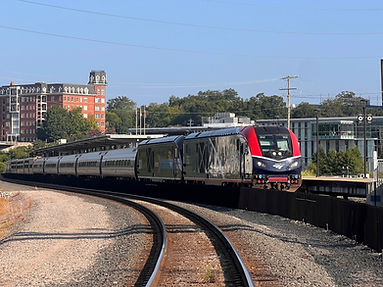
Standing on the platform with my phone in hand, I’ll admit I was a little disappointed by what arrived. Pulling in was a standard gray Amtrak Diesel-Electric locomotive hauling three Superliners, with a backwards-facing engine on the rear. While slightly disappointing, it wasn’t unexpected. Due to Amtrak’s ongoing equipment shortage, the Horizon Cars have since been replaced with Superliners, and the locomotives in use are standard Amtrak units, reliable but not exactly flashy or “foamer material.” The use of Superliners also eliminated the business-class seating that had previously been offered with the Horizon equipment.
That said, I had never ridden in Superliners before, and the novelty quickly won me over. The extra space and elevated seating gave the trip a different feel than most Midwest corridor services. At the end of the day, the most important thing is that the service exists at all, and that Amtrak was able to keep it running with the equipment available.
We departed the airport station and headed southbound toward Chicago. The scenery was a mix of open fields, suburbs, and industrial areas, views that a typical commuter might ignore but ones I took in completely. Traveling at nearly 80 miles per hour while being able to get up, stretch your legs, and move around comfortably is something many Ohioans don’t get to experience. The train maintained 79 mph for much of the route, offering smooth, predictable travel the entire way.
There was no stop-and-go traffic and no stress about delays, just steady progress between two major Midwest cities.
Once in Chicago, the plan was to spend some time in Union Station before catching my next train, the Hiawatha. I arrived in the early evening, so I didn’t have the luxury of playing tourist, but I didn’t mind. I was a transit nerd in one of the largest train stations in the United States, and there are certainly worse places to be.
I had about an hour before the last northbound Hiawatha service, so I walked the station, grabbed food from one of the many vendors, and took in the atmosphere. Watching the arrivals and departures board, listening to the overhead announcements, hearing the hum of locomotives and the bells from engines arriving and departing, it all felt alive. What struck me most was that this is a routine experience for the average Chicagoan, while the average Ohioan has largely been deprived of it.
As I lined up to board the northbound Hiawatha, I noticed something unexpected. I was getting back on the exact same train I had arrived on. Because I had taken the final Borealis run of the day, the train’s designation was simply changed to the Hiawatha for the return trip. In theory, I could have stayed onboard during the layover if it had been permitted.
As I rode back to Milwaukee, I reflected on the experience and how much is missing back home. Coming from Cincinnati, the distance between Chicago and Milwaukee felt familiar. It’s roughly the same as the trip between Cincinnati and Dayton. Experiencing reliable, frequent passenger rail over that distance made it easy to imagine what similar service could look like in Ohio, especially with the long-anticipated 3C+D corridor.
I’ve long wished that Cincinnati and Dayton had a Hiawatha-style service. If you’re a regular commuter along I-75, I’d argue you’d agree.
Final Wrap-Up
What this trip ultimately reinforced for me is that good passenger rail doesn’t have to be high-speed or flashy to be transformative. It simply has to be frequent, reliable, and well integrated into the places it serves. The Borealis and Hiawatha pairing quietly delivers all three, offering a practical alternative to driving while making regional travel feel accessible and human. For places like Ohio that are still waiting for meaningful intercity rail, experiences like this inspire optimism by providing a clear, tangible blueprint for what’s possible.
I strongly encourage anyone to ride the rails whenever they can. To sum up this entire experience, I leave you with a line from one of my favorite rail-themed films:
“One thing about trains: it doesn’t matter where they’re going. What matters is deciding to get on.”
- Tom Hanks, The Polar Express (2004)



ABOUT ALL ABOARD OHIO
All Aboard Ohio is a non-profit, member-based organization dedicated to promoting improved public transportation and passenger rail service throughout the state.
Founded in 1973 and incorporated as a registered 501c-3 in 1987, All Aboard Ohio has spent more than 50 years advocating, educating, and working towards our goal of a connected Midwest
All Aboard Ohio is a 501c-3 nonprofit with over 50 years of advocacy work, advocating for improved public transportation and passenger rail service in the Midwest
©2025 by All Aboard Ohio
Get in Touch
3136 Kingsdale Center,
#112 Columbus, OH 43221
Federal Tax ID: 31-1066182


