55 Years of Amtrak - How Amtrak Succeeds
Today, Amtrak’s 55th anniversary isn’t all that’s being celebrated. The U.S. is experiencing a veritable resurgence of passenger rail which some have described as a renaissance. Demand is at an all-time high, and routes from the west coast to the east coast are reporting unprecedented volumes of passengers. Rather than fighting to preserve a dying train network, Amtrak is breaking its own records every year.

February 14, 2026
May 1, 1971, A crowd of passengers gathered along the platforms underneath what remained of New York’s storied Penn Station. Among them were the red-eye travelers, patiently awaiting the midnight departure down the Northeast Corridor. Others, perhaps, were beginning their very late-night commutes, eager to return to their homes in New Jersey after a long day of work. This routine was familiar to hundreds of thousands of people every day, all cramming through the crowded concourses below Manhattan to catch one of the many trains that had run through the country’s most famous station for more than half a century.
Just past midnight, the arrival bound for Philadelphia crept up to the platform and opened its doors to the undoubtedly weary travelers. To most of them, not much looked out of the ordinary; a familiar jet-black locomotive led its usual consist of coaches that had belonged to the Pennsylvania Railroad on its hourly route that passengers had affectionately named the “Clocker”.
Very little about its appearance would’ve suggested that this train now ran under a different name. It had not yet been adorned with an iconic livery of stripes painted red, white, and blue to mirror the colors of the Star-Spangled Banner. Absent too were the matching chevrons that would’ve pointed ahead into the dark tunnels burrowing under the Hudson River. Yet on the departures board at Penn Station, the midnight slot lit up to show the first-ever Amtrak train had arrived in New York City.
55 years ago, America’s national passenger railroad was born.

At the time, intercity rail was in extraordinarily bad shape. Amtrak was created as a federally-owned and operated company to salvage what was left of a disjointed and massively declining network of passenger trains. The privately-owned railroads that had once reached into every corner of the country were a shell of their former selves. Long-distance and short regional routes relied upon by thousands of people per day were shuttered. Small towns and even larger cities that had grown along the rail lines were permanently cut off, many left with no passenger service whatsoever.
The railroads that had built America were falling apart. This continued for decades still; every year, more and more routes were lost with no plan to return. Their stations were abandoned and torn down. Over time, the United States became a “fly and drive” country, and the trains that were left felt like little more than a relic of the past.

Today, Amtrak’s 55th anniversary isn’t all that’s being celebrated. The U.S. is experiencing a veritable resurgence of passenger rail which some have described as a renaissance. Demand is at an all-time high, and routes from the west coast to the east coast are reporting unprecedented volumes of passengers. Rather than fighting to preserve a dying train network, Amtrak is breaking its own records every year.

Of course, the U.S. is still far from a rail utopia. To this day, the vast majority of Americans have never been on a train in their lives. But with the recent introduction of multiple new routes and the ongoing expansion of existing services, Amtrak is demonstrating that there is a rapidly growing appetite for travel by train all over the country.

So what's been happening to fuel this growth? And what is there to look forward to in the coming years?
This past August saw the launch of Amtrak’s long-awaited Gulf Coast service in Louisiana, Mississippi, and Alabama. This corridor had not seen a passenger train in almost twenty years since the original Gulf Coast Limited ran between New Orleans and Mobile before Hurricane Katrina. Dubbed the Mardi Gras Service, Amtrak’s revival of the line doubled its ridership expectations within months, and more capacity was added to keep up with skyrocketing demand.

The Mardi Gras is the newest example of a “state-supported” Amtrak service. This is in contrast to the federally-subsidized long-distance network, a collection of routes stretching between far-apart cities with only one daily round trip (at best). Those sleeper trains are famous for their front-row seat to some of the country’s most spectacular scenery. A ride on a long-distance train is often treated as a vacation, like a “land cruise”; though not a practical means of getting from Point A to Point B.
State-supported routes, on the other hand, are designed to compete more directly with road and air travel. These are subsidized in part by the federal government but largely by states aiming to connect their nearby population centers as well as those in neighboring states. By comparison, these routes are shorter and more punctual; and they offer the flexibility of multiple daily round trips.

The previous summer, Minnesota debuted its first state-supported route in cooperation with Wisconsin and Illinois. The Borealis, as it was named, supplemented the long-distance Empire Builder along the Twin Cities-Milwaukee-Chicago corridor. Before the route opened, overland travel options in this region were consistently in high demand. The daily Empire Builder was often sold-out days (even weeks) in advance, and intercity buses were packed. The introduction of the Borealis added one daily round trip with more expected as ridership continues to grow far beyond initial projections – according to Amtrak, a 227% year-over-year “surge” along the corridor since its launch in 2024.

The Borealis is Amtrak’s latest addition to the Chicago hub network, joining eight other state-supported routes that fall under the Amtrak Midwest family.

Thanks to the Corridor Identification and Development program initiated under the Bipartisan Infrastructure Law in 2021, several proposed routes in the region are under study, and some have received funding to begin service in the next few years.

The Northeast Corridor, or NEC, predictably continues to be the country’s powerhouse for passenger rail. Close to half of the Amtrak’s state-supported routes are clustered here alongside the fastest train in North America: the Acela.

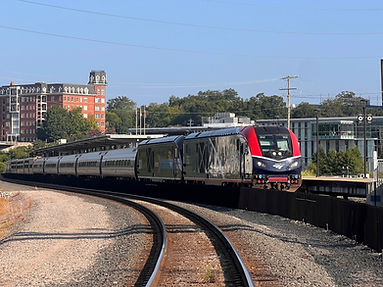
Currently, this is the closest that any part of the Americas has come to achieving "true" high-speed rail, and indeed, some sections of it are capable of supporting top speeds above the international threshold for high-speed rail. In 2025, Amtrak introduced its NexGen Acela trainsets (Alstom’s Avelia Liberty) capable of topping out at 160 miles per hour. Though the corridor’s top speed is still limited by track geometry and aging infrastructure, the new tilting trainsets can traverse curves more quickly and offer significantly improved acceleration. This NexGen fleet has sped up express trips between some of the country’s largest population centers while offering new amenities and a more modern rider experience.

The long-awaited Acela upgrades were met with plenty of excitement in 2025; but that doesn’t mark the end of Amtrak’s ongoing fleet modernization. This year, the very first trainsets from the new Airo family will go into service on the Cascades route in the Pacific Northwest.

Eighty-three Airo trains are being rolled out to replace their 50-year-old predecessors with a focus on speed, comfort, cleanliness, and accessibility. After their debut on the Cascades route, they will enter into service on east coast routes beginning in 2027.
Many of these Airo trains will be produced at Siemens’ new plant in North Carolina, adding extra manufacturing capacity beyond the existing facility in California. Together, they will allow several routes to receive these Airo trainsets as well as modern Venture coaches which are already in use on some state-supported services.

Amtrak’s network has grown considerably in recent years, both by opening brand-new routes like the Mardi Gras and Borealis and by revamping service on existing corridors. As more and more projects cut their ribbons, and as more states tout record ridership, Americans who might not have ever been on a train are beginning to see how intercity rail can impact their communities.

Looking back, Amtrak has come an incredibly long way since its first train rolled out of New York 55 years ago. It began serving the U.S. when our railroads were at an all-time low, mired by decades of neglect, decay, and disrepair. Now, it’s reminding us how crucial passenger rail is to the growth and sustainability of our country.
Recent years have seen an unprecedented amount of investment as Americans everywhere show their eagerness for modern train travel. This investment has produced record-breaking performance from the northeast megalopolis to Southern California; from the Chicago hub to the Cascade mountains. All across the country, the desire for passenger trains is strong, just as it was when the first railroads crossed the U.S. and helped grow the places we now call home.
As Amtrak looks ahead to the coming years, what new records will be set? What communities will see trains return for the first time in decades? What stories might we tell in another 55 years when we look back upon today and remember the beginning of America’s rail renaissance?



ABOUT ALL ABOARD OHIO
All Aboard Ohio is a non-profit, member-based organization dedicated to promoting improved public transportation and passenger rail service throughout the state.
Founded in 1973 and incorporated as a registered 501c-3 in 1987, All Aboard Ohio has spent more than 50 years advocating, educating, and working towards our goal of a connected Midwest
All Aboard Ohio is a 501c-3 nonprofit with over 50 years of advocacy work, advocating for improved public transportation and passenger rail service in the Midwest
©2025 by All Aboard Ohio
Get in Touch
3136 Kingsdale Center,
#112 Columbus, OH 43221
Federal Tax ID: 31-1066182


