
Demand for public transportation is on the rise. Recently, there was bipartisan support for Ohio to rejoin the Midwest Interstate Passenger Rail Commission, a positive step towards bringing more Amtrak lines to Ohio and fostering better communication between states.
But, passenger rail between our cities is incomplete without high-quality public transit once we get to them. From bus rapid transit (BRT) to light rail and commuter rail, people want premium public transit options that can enable end-to-end car free journeys.
So, what more is needed to expand public transportation in our cities? The answer lies in density. People living closer together can create a larger ridership base, which will in turn boost demand for public transit and justify development.
Density Enables Transit
Increased population density is key to city growth. Denser neighborhoods promote walkability, reduce reliance on personal vehicles, and shorten commute times. In densely populated areas, people are more likely to live, work, and socialize within close proximity, making transit a practical option for daily commutes. Moreover, cities with higher density are better positioned to fund and maintain essential infrastructure, like roads, public transportation, and waste management, thanks to higher tax revenue from a larger population. With Columbus expecting to add up to a million new residents in the next 25 years, density will be a crucial factor for effective city growth and expanding public transit.
One way to enable density is with zoning changes that promote “missing middle” housing in previously very-low-density areas.
“Missing Middle” housing refers to a range of multi-unit or clustered housing types that fill the gap between single-family homes and large apartment complexes. Examples include duplexes, triplexes, and townhouses. These housing options are designed to provide diverse and affordable choices that address the shortage of mid-sized housing in many neighborhoods. They’re also an important realization that density doesn’t have to be large apartments or 5+ story buildings.

Recent zoning changes have made significant progress in enabling more dense developments and easing restrictions for developers in Columbus and Cincinnati. The passage of “Connected Communities” and “ZoneIn”, respectively, promote multifamily housing and are a key step toward addressing the "missing middle" housing gap and building demand for transit.
Transit Development in Ohio
Now that Ohio’s cities are enabling more dense housing, why is development of the transit to match taking time? It's easy to look at cities like Seattle, which has built one of the most advanced light rail systems in the country. Or Austin, which recently unveiled more detailed plans for its 9.8 mile rail route from the airport, through downtown and ask, "Why can’t we do that now?”.
Every city has its unique challenges that are being worked through. While these cities have similar populations, Columbus is currently much more spread out, and needs to infill it’s density to justify some forms of transit. Cincinnati has the largest historic district in the country, which limits available space for development. Cleveland has existing rail but suffers from suburban sprawl, which is preventing new rail development priorities.
Our cities are learning from others: Seattle didn't start with light rail—they first had a comprehensive bus system that laid the foundation for light rail. Ohio is moving toward a similar vision. Major bus system overhauls and investment in BRT systems and streetcars have already been made in our three largest cities. Research has shown that dense developments around desirable high-quality transit corridors, like those that BRT brings, means we’re accelerating Ohio’s density journey. And as we’ve said: as density grows, so can our transit investments. Perhaps leading to a robust light rail network in all of Ohio’s cities in the future.

Our Density Journey is Underway
Ohio is taking intentional steps to enable our communities to have desirable, high quality, transit networks in the future. After all, public transportation is not just about mobility—it’s about rethinking how cities grow and how communities connect. Transportation systems will shape the urban landscape, fostering more inclusive, resilient, and connected communities. Our first steps towards this future are underway, policies that create the density needed like ZoneIn, LinkUs, and Connected Communities have passed. And as these policies mature, transit to match will rise with light rail connecting dense urban cores and BRT routes allowing for fast implementation of transit where it matters most.
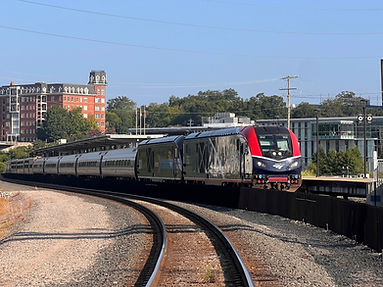
And one day, we’ll be able to step off a high-quality passenger train from one city to another, and step right on to a local transit system to match. This is how we create a connected midwest!

Ben Paulus
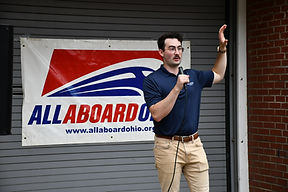
Ben Paulus is a communications strategist at All Aboard Ohio with professional experience in city development


ABOUT ALL ABOARD OHIO
All Aboard Ohio is a non-profit, member-based organization dedicated to promoting improved public transportation and passenger rail service throughout the state.
Founded in 1973 and incorporated as a registered 501c-3 in 1987, All Aboard Ohio has spent more than 50 years advocating, educating, and working towards our goal of a connected Midwest
All Aboard Ohio is a 501c-3 nonprofit with over 50 years of advocacy work, advocating for improved public transportation and passenger rail service in the Midwest
©2025 by All Aboard Ohio
Get in Touch
3136 Kingsdale Center,
#112 Columbus, OH 43221
Federal Tax ID: 31-1066182


