Big Changes to Federal Passenger Rail Funding Program - The Impact
In December the Federal Railroad Administration announced updates to the Corridor ID program. These updates tailor next steps of the program towards the complexity of projects to smooth the ability to receive approvals and confidence from the federal government. This impacts routes in Ohio like those through Columbus, Cleveland, Cincinnati, and Toledo.
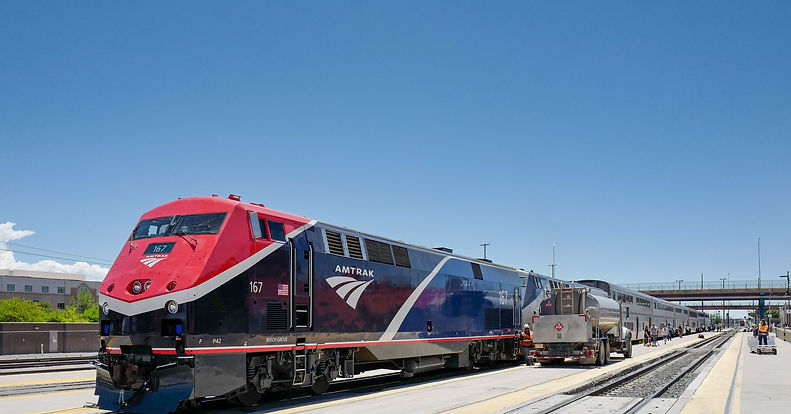
January 14, 2026
Ryan Pecaut
The Federal Railroad Administration (FRA) held a policy update webinar in December, announcing significant structural changes to the Corridor Identification and Development (Corridor ID) Program. The updates are designed to better tailor federal resources to the specific readiness levels of different rail corridors, splitting the planning process into "Core" and "Near-Term" tracks.
For advocates and stakeholders in Ohio, these changes clarify the path forward for both new routes, such as the 3C+D, and improvements to existing services like the Cardinal.
Recap: What is Corridor ID?
Established under the Bipartisan Infrastructure Law, the Corridor ID Program is the FRA’s primary pipeline for intercity passenger rail development. Selection into the program provides corridors with seed money for planning and gives them priority for future implementation funding under the Federal-State Partnership for Intercity Passenger Rail program.
The program consists of three steps:
Scope, Schedule, and Budget.
Service Development Plan (SDP).
Project Development (Preliminary Engineering and NEPA).

Ohio’s Place in the Program
In December 2023, the FRA selected four Ohio-centric corridors for the program. The new policies announced this week will likely influence how these specific routes proceed through Step 2 after having completed Step 1:
Cleveland-Columbus-Dayton-Cincinnati (3C+D): A new service proposal.
Midwest Connect (Chicago-Fort Wayne-Columbus-Pittsburgh): A new service proposal.
Cleveland-Toledo-Detroit: An extension of existing corridors.
Daily Cardinal (Chicago-Cincinnati-DC): An improvement to existing long-distance service.
The "Core SDP": A "Feasibility First" Approach
The FRA acknowledged that requiring deep technical analysis too early can stall new corridors. For routes with little prior planning—likely applicable to the 3C+D and Midwest Connect—the FRA is introducing the Core Service Development Plan (Core SDP).
Rather than immediately funding expensive, detailed engineering and micro-simulation modeling, the Core SDP focuses on establishing fundamental feasibility. Sponsors must complete three "Core Planning Elements":
Market Analysis: Proving ridership demand and economic connection.
Feasibility Study: Identifying high-level infrastructure needs and costs.
Initial Timetables: Developing conceptual schedules.
FRA officials noted that host railroads have expressed concern regarding "robust engagement" on corridors that are not yet defined. The Core SDP aims to solve this by using "parametric models" (high-level capacity estimates) rather than detailed simulations to prove viability first. Once a corridor passes the Core SDP review, it can graduate to a Comprehensive SDP for detailed design.

The "Near-Term SDP": Fast-Tracking Existing Improvements
For corridors that already have trains running—such as the route used by the Cardinal—the FRA introduced the Near-Term SDP.
This mechanism allows sponsors to strip out specific, ready-to-go capital projects (such as new passing sidings, signal upgrades, or station improvements) and advance them to construction funding immediately, without waiting for the full corridor-wide study to be completed. To qualify, projects must be located on track segments where passenger service currently exists and have stakeholder support.
Timeline and Funding
The FRA announced it targets opening the Step 2 Directed Notice of Funding Opportunity (NOFO) in January 2026. This is the administrative mechanism that will release funds to sponsors to begin their Service Development Plans.
Furthermore, for regions looking to propose entirely new routes not currently in the program, the FRA targets opening the next competitive application round later in calendar year 2026.
What This Means for Ohio: A Faster, Safer Track for Expansion
For the Ohio Rail Development Commission (ORDC) and advocates like All Aboard Ohio, these changes remove the primary bottleneck that has historically stalled rail expansion in the state: the "All-or-Nothing" Trap.
Previously, new routes like the 3C+D were often treated as massive, monolithic construction projects requiring hundreds of millions of dollars in engineering work before a single question about service could be answered. The new rules break this deadlock.
1. The 3C+D and Midwest Connect: Avoiding the "Paperwork Purgatory"
The 3C+D (Cleveland-Columbus-Dayton-Cincinnati), Cleveland-Toledo-Detroit and Midwest Connect (Chicago-Columbus-Pittsburgh) are "New Conventional Rail" corridors. Under the old rules, moving them forward might have required expensive, high-fidelity computer simulations ("micro-simulations") of every freight train on the tracks—a process that often triggers immediate resistance from host railroads like Norfolk Southern and CSX.
The "Core SDP" Advantage: By placing these routes into a "Core Service Development Plan," Ohio can likely bypass those complex simulations for now. Instead, the state can use "parametric modeling"—a faster, math-based method—to prove that the passenger trains fit on the tracks.
The Benefit: This prevents the railroads from stalling the project with demands for perfect data too early in the process. It allows Ohio to secure a federal "Yes" on feasibility faster and cheaper than before.
2. The Cardinal: Immediate Wins for Cincinnati
The daily Cardinal service (Chicago-Cincinnati-DC) falls under the "Existing Service" category, making it a prime candidate for the new "Near-Term SDP."
The "Unbundling" Effect: Instead of waiting for a years-long study of the entire 1,000-mile route to finish, planners can now "unbundle" specific upgrades in Ohio—such as station improvements in Cincinnati or passing sidings in Butler County—and advance them to construction immediately.
Why it Matters: If a project is "shovel-ready" and has stakeholder support, it no longer has to wait for the rest of the corridor to catch up. We could see physical improvements on the ground in Ohio years earlier than expected.

3. The "Checkpoint" is a Good Thing
While the new policy adds a "Feasibility Checkpoint," Ohio is uniquely positioned to pass it. Unlike "lines on a map" proposed elsewhere, Ohio's corridors connect major population centers and have been studied for decades. The "Core SDP" will essentially ask: Is there people-moving demand, and can it be built? For Ohio, the data says yes. This new rule essentially gives the FRA a formal way to stamp "APPROVED" on that data quickly, shielding the project from future political skepticism.

Ryan Pecaut
Ryan Pecaut is the communications strategy lead at All Aboard Ohio and a career professional in transportation analytics


ABOUT ALL ABOARD OHIO
All Aboard Ohio is a non-profit, member-based organization dedicated to promoting improved public transportation and passenger rail service throughout the state.
Founded in 1973 and incorporated as a registered 501c-3 in 1987, All Aboard Ohio has spent more than 50 years advocating, educating, and working towards our goal of a connected Midwest
All Aboard Ohio is a 501c-3 nonprofit with over 50 years of advocacy work, advocating for improved public transportation and passenger rail service in the Midwest
©2025 by All Aboard Ohio
Get in Touch
3136 Kingsdale Center,
#112 Columbus, OH 43221
Federal Tax ID: 31-1066182


